
One in four children are now designated as needing specialised support. But our funding system is built for one in fifty.
hen most people think about disability in schools, they usually imagine children in wheelchairs, non-verbal children with multiple complex health needs, and children with profound intellectual disabilities.
But when you talk to teachers, leaders, or families with kids in actual Australian schools, they talk about kids with ADHD, autism, language delay, poor executive functioning, and motor delay. They talk about kids who fidget and squirm, and who have big feelings and big behaviours that interrupt class.
The growth in the number of children with disabilities in education settings is extraordinary.1 Over the last decade, the proportion of children identified by their teachers as having a disability in school in Australia has grown from 18% to 27% of all children. These are not necessarily children with formal diagnoses, but rather children who have been flagged by their teacher as requiring extra support due to disability.
More than one in four Australian school students receives support for a disability (up from fewer than one in five a decade ago)
Share of school students with a disability by level of support
Loading CSV data...
QDTP is an abbreviation for Quality Differentiated Teaching Practice which is the first level of adjustment within the national framework| Source: Australian Curriculum, Assessment and Reporting Authority
© Inflection Points, 2026.
There are four measured categories of disability: physical, sensory, cognitive, and social-emotional. The bulk of the growth has been in the latter two categories: cognitive disability, which includes intellectual disability, global developmental delay, and dyslexia; and social/emotional disability, which includes ADHD and autism. Nearly one in four children in every classroom is now assigned to one of these two disability categories.
The acceleration of need has driven massive increases in spending, with the Australian Government alone spending $5.1 billion a year on disability loadings in schools, and the states and territories spending at least that much again. That’s the same order of magnitude as is spent on the JobSeeker program.
When faced with escalating needs and real concerns about financial sustainability, one instinct is to get increasingly hard-nosed about ensuring children ‘really’ need funded support. With that instinct comes calls for higher bars for access to funding, and more scrutiny of applications. For example, the Australian Government is using revised guidelines to target the “inappropriate allocation and use” of $463 million in disability resourcing over the forward estimates.
But doubling down on individualised disability funding, including through investing more and more in ensuring the integrity of individual applications for funding, is the wrong approach.
Change the model of funding, not the amount
If we want to fix the issues associated with disability in schools and early childhood education—including escalating costs, rising complexity, and—most importantly—exclusion and poor outcomes for students with disability, then we need to stop trying to fund individual children as much as possible, and instead embed resourcing and expertise to support effective inclusion across schools as a whole. This means providing schools with at least as much resourcing as they get right now to support inclusion—while radically limiting the right for schools to apply for individualised funding through, for example, extensive assessment processes with very high thresholds for entry.
Subscribe today
Inflection Points is Australia's newest, greatest and only long-form policy magazine.
Subscribe today
Inflection Points is Australia's newest, greatest and only long-form policy magazine.
This is not an argument for reducing the overall pool of funds available to schools supporting disability. There are no easy savings to be made here. Instead, this is an argument for changing how funding is allocated to schools, and for making that funding deliberate, predictable and effective.
Individualised funding creates an accountability sink
Individualised funding imagines there is a ‘right’ support that will ‘fix’ the child sufficiently to take part in their education, like a key and a lock, or a ramp and a wheelchair. But in real life, we can see that the impacts of disability arise as much from the ways we structure our lives as they do from the inherent characteristics of a child with disability.
Imagining that all it takes to solve our problems is a hypothetical amount of funding for any particular child leaves no one responsible for the outcome, and both teachers and administrators can end up feeling that their role has been reduced to simply applying for or allocating funds.
What’s more, the behaviour of people within systems changes in response to the way we set up systems. Set up a disability-focused funding stream, and watch how quickly behaviours that sit in the grey—“Is it trauma? Is it autism? Is it both?”—get classified as being related to disability.
Often this change in behaviour is viewed by public commentators, and perhaps by system operators—or at least their Treasuries—as cynical: that the need is not ‘real’, but simply an attempt by schools to ‘get something’ by identifying their students as having a disability.
It is my sense that this is both wildly unfair to practitioners in the system, and not a very helpful observation for system managers.
A much more helpful way is to look at this kind of emergent behaviour as one of information flows, and understand the behaviour of identifying increasing numbers of children with disability as a signal that something is up.
If teachers start identifying trauma-related complex behaviours as ‘complex social emotional disability’, it is not because they are ‘gaming the system’—it is because they have information they need to pass up the system—“Help!”—and the individual funding application is the only pathway that information can travel.
Rather than providing a pathway for that information into the system, individualised funding models have the opposite effect, providing a dead end for that information in the form of a funding application, and operating as what Dan Davies calls “an accountability sink”.
By focusing on defining the individual child’s needs, individualised funding processes make it easier for policy makers, system administrators, and school staff to avoid “awkward and unpleasant” conversations about whether a broader change is required to reshape the context in which the child is operating.
Over a third of early primary age children who receive disability support have an unstable pattern of funding
Eligibility status of funding for students recieving any adjustments from reception to year 3
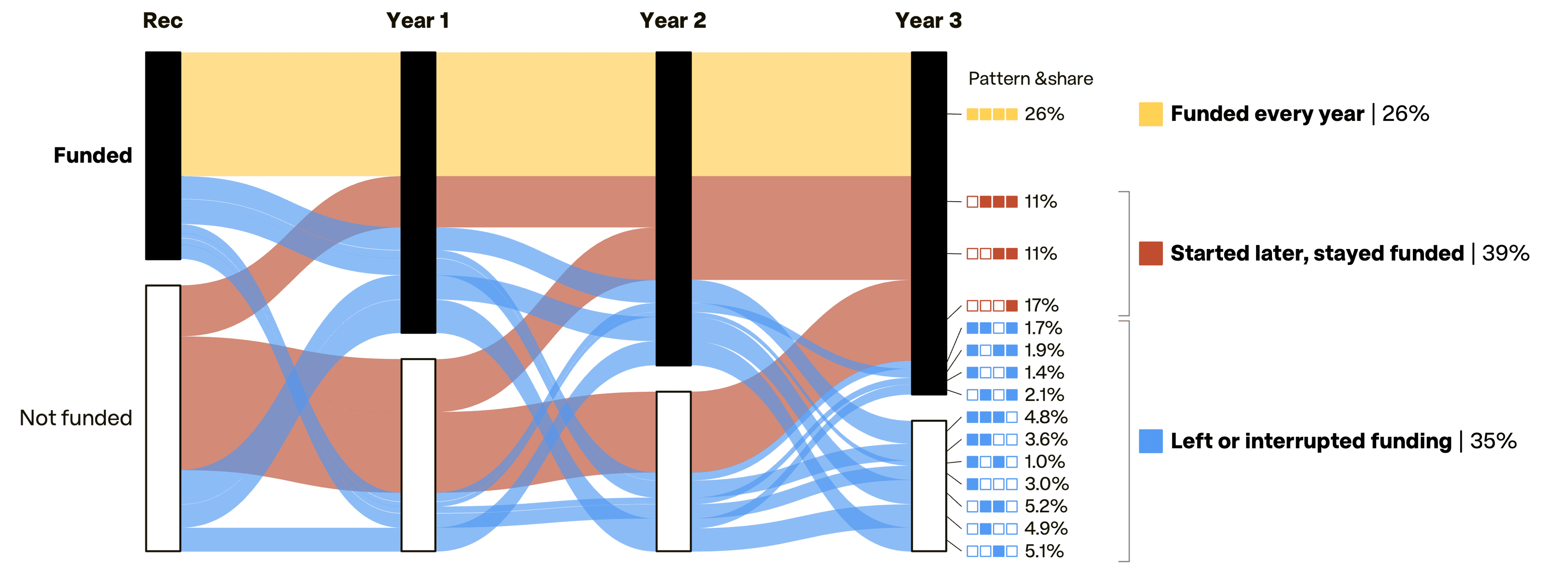
Source: Montgomerie et al. (2026), BetterStart Group, Adelaide University; Inflection Points data visualisation
© Inflection Points, 2026.
Individualised funding also has a timing problem. For children with social-emotional and cognitive disabilities there are often no easily provided tests that produce evidence of disability or functional need in advance of the need arising. The need must necessarily be demonstrated through challenges observed in the classroom. In this way the system unintentionally rewards failure, while offering no incentives for up-front inclusion.
Case study: Sam, Year 4, Individual Funding
To give you a sense of how the system currently works, let me introduce you to Sam. He’s a quirky kid, has trouble sitting still, and finds it hard to make friends. He loves Ninjago and Pokemon. Sam is nine years old, and entering Year Four. His story plays out like this:
- Sam enters Year Four in a rambunctious class, so it takes a term or so for the teacher to notice how often he isn’t taking part, and how agitated he becomes when encouraged to get involved. Sam doesn’t have a diagnosis. The teacher raises this at the parent teacher interview, suggesting that a formal assessment might help Sam get some additional resourcing. His parents feel a bit overwhelmed by hearing how Sam is behaving and the suggestion that he may have a ‘condition’, and aren’t keen to progress down this path.
- The teacher makes adjustments based on their experience with other similar children. They move Sam to a space where he can do his own thing, and make a visual timetable to support his organisation.Block Field
- But Sam’s behaviour in class keeps escalating—he calls out when he’s bored (which is increasingly often), he refuses to stop being on the iPad when it needs to go away. This leads to increasingly loud and foul-mouthed confrontations. Increasingly, he stops even pretending to do work.
- The teacher asks the principal for help. The principal arranges expert advice, asks the teacher to document Sam’s challenges, and uses internal school resourcing for a few hours a day of one-on-one teacher’s aide support to keep Sam more ‘on task’ during class.
- The expert advice arrives a few weeks later. The advisor offers some thoughts on how to support Sam to identify and ‘self-regulate’ his feelings, including through using a program called ‘zones of regulation’.
- They also notice that Sam’s behaviour gets particularly tricky during literacy blocks, and recommends Sam take a more detailed literacy screener.
- The advisor then supports the school to apply for extra resourcing in the form of ongoing funding for a teacher’s aide. The system approves ongoing funding for 8 hours of teacher’s aide funding a week.
- Three other children in Sam’s class also have individualised funding—two arrived already ‘funded’, and one has been on a similar journey to Sam. This means that the teacher’s aide is in the classroom full time, moving between them. Increasingly, all four children become the responsibility of the teacher’s aide, and they become separated from the class as a whole.
- As a result of the screener, Sam starts being taken out of class for a small group literacy program led by a teacher’s aide, working to a highly-structured, evidence-based program. He does okay with the content, but it doesn’t seem to increase his engagement with reading in the classroom.
- It feels like a tightrope, but between the teacher’s aide time, the classroom strategies, and a fair amount of time spent out of the classroom when his behaviour escalates (including through increasingly regular informal suspensions or ‘take homes’), Sam makes it through the year. Everyone is exhausted and can’t wait for holidays.
The story of Sam in the box above is loosely based on hundreds of similar cases I saw while working in the Department for Education in South Australia. As a public servant, I led a division of 650 FTE supporting the inclusion of around 20,000 students across around 800 South Australian public school and preschool sites, through funding and specialist support via our allied health workforce.
And when I and my family stepped into an informal kinship caring role, we experienced the impact of social/emotional disability in education first-hand.
It was discomfiting as a policy maker to be reminded in my home life, year after year, that getting more funding or the right experts was no silver bullet.
In fact, whether our child made it through the day, the week, or, eventually, the term without melting down and being sent home depended most on the fragile chemistry of the classroom—the teacher, the teacher’s aide, the other kids, the things they were working on, even the weather. Funding and expertise can help to get that chemistry right, but in no way guarantees good outcomes.
The reality is that the outcomes for kids like Sam or my own would have been better had additional resourcing for disability inclusion had been embedded in the school up-front, and—counterintuitively—if there had been no option to apply for individualised resourcing, removing the ability for schools to let themselves off the hook for his outcomes.
Money for schools, not individuals
Education policy makers often talk about the need to embed more upfront funding to reduce the needs of children escalating further. The reality is that we need to both embed up-front funding and reduce avenues for individualised funding: schools must have access to sufficient resourcing to make meaningful investments in response to local needs—but they also need to have no expectation of getting more resourcing if those investments don’t deliver the expected outcomes.
As long as a plausible pathway to individualised funding exists, it will continue to act as an accountability sink that enables schools and system administrators to avoid looking at what is and isn’t working locally, and in centrally provided supports.
Allocating resources without tying them to individual students
As far as I am aware, there is no Australian school system, be it public, Catholic Education or independent, that has taken the step of dramatically increasing up-front investment in disability inclusion while radically restricting the ability of schools to access individualised funding.2
Although embedded funding is popular as an idea, there are three significant questions that prevent education policy makers from allocating the lion’s share of funding up-front and doing away with most individualised funding.
First, how will administrators decide how to allocate resources?
Second, what will stop schools spending up-front funding just as poorly?
And third, how will schools be held to account for how they use their funding?
Fortunately, all these questions can be answered.
Close enough early is better than precisely too late
Paradoxically, the task of allocating funding has become easier as the number of children with needs has risen. At one in four, we have now moved from the unpredictable long tail and into the much easier to predict part of the normal distribution.
There will, of course, always need to be recourse to individualised funding for children with profound and complex disabilities, those with very extensive needs—the 1 in 50 whose need for one-on-one support to undertake daily activities will not be met within a school’s funding allocation.
However, for the remaining students’ needs, the answer lies in the comprehensive data about individual students that school system administrators today already possess.
Administrators can use de-identified, linked administrative data to understand the likely need for disability support in their cohort.
This is a good start, but of course none of the various administrative datasets will provide a perfect picture of exactly which children have a disability, what the nature of their disability may be, and when they will enter the schooling system.3 But it is perfectly reasonable to imagine that the data we have today could be a fair match with current individualised application processes.
Is a ‘fair match’ sufficient for the purpose of allocating disability resourcing?
Here, timing matters. I care deeply about children getting what they need. I don’t want to ask schools to spend more and more of their scarce time on precisely specifying the child’s needs for the purposes of funding, especially when we know that those needs will change over time, and are deeply context dependent.
I would prefer schools spend their time planning how to use disability inclusion resourcing, reflecting on what is working, and adjusting their practice in response to that reflection.
Because, as it happens, and as Sam’s story shows, schools often use disability resourcing to buy things that on the surface appear to make classrooms calmer and easier, but which aren’t actually good for children.
In particular, despite good evidence that one-on-one support by teacher’s aides often leads to poorer educational outcomes—including learned helplessness, reduced interaction with teachers, and isolation from peers—this kind of support has taken the lion’s share of increased disability funding over the last decade. Between 2014 and 2023, South Australia’s public education system added 7.5 student support officers for every 1 additional teacher.4 In New South Wales, the education support workforce in schools grew by 55%, compared with a 13% increase in the number of teachers.5
Deploying funding at the level of the school
One of the pernicious impacts of an individualised funding model is it unintentionally avoids conversations about prioritisation by pretending that there are no choices to be made.
But when it comes to solving problems or building new things, constraints are helpful. They are helpful because they enable us to make choices.
Putting aside the question of money for a moment, there are real constraints facing teachers and leaders that require them to prioritise.
The key constraint is time. Leader and teacher time are scarce, and while money can help allay this somewhat, there is still only a finite amount of time. A teacher only has so many opportunities to try new routines and layouts before the classroom becomes too chaotic; only so much time to reflect on and adapt pedagogical approaches; can only tailor the curriculum to different entry points so much before the content loses coherence. The teacher has to exercise judgment about where to start, what to do, and how to make that work in a busy classroom.
Individualised funding allows a pretence that those choices don’t need to be made, because you can just ‘fund’ more adjustments.
What’s worse, in relying on individualised support, scarce teacher and leader time and energy goes to the application process and the argument about whether enough funding has been allocated, rather than to the real question: how might we best utilise our limited funding and time?
Fortunately, there is an evidence-based framework to support schools to make better decisions that is increasingly well supported across education settings by academics, inclusive education leaders and policy-makers. The framework is called Multi-Tiered Systems of Support (MTSS).6
MTSS is a way of matching the intensity of support to a child’s identified need, whether academic, behavioural or wellbeing, as early as possible. That need is found through universal screening of every student, not through a disability label. A child doesn’t need a diagnosis to receive more intensive support, and having one doesn’t, by itself, place them anywhere.
In most implementations, MTSS describes three tiers of support, each more intensive than the last, and each delivered ‘on top’ of the one below:
- Tier 1: High-quality, evidence-based instruction and supports for all students.
- Tier 2: Targeted, small-group interventions for students who need more.
- Tier 3: Intensive, individualised interventions for students with the highest needs.
The tiers describe levels of support, not categories of children. A child whose screening shows they need Tier 2 or Tier 3 support in a particular domain gets it straight away, rather than first having to fail at the tier below. Progress monitoring then moves them up or down as their needs change. Supports are faded out when goals are met and brought back if a child falls behind again.7
This approach is increasingly prominent worldwide. While not explicitly framed in the context of school interventions, the recent UK Fonagy Review called for a “needs-led” system to respond to increasing incidence of autism, ADHD and mental health disorders. The review describes a need to focus on “the intensity of response, not categories of people”, and explicitly favours matching support to need from the outset, over making people climb through fixed levels to reach it. The total pool of resourcing, therefore, should be tied to the expected distribution of need within the population, rather than individuals.
When a child’s need is tied mainly to a funding decision, the incentive is to document their deficits. But when a child’s need is tied mainly to a decision about how to support them, the incentive is to identify and document their needs—and to do so as early as possible. We can build better incentives simply by tying resources to a data-led analysis of cohorts, rather than case studies of individuals.
Note that it is the focus on Tier 1 supports—focused on helping teachers to deliver high-quality universal instruction—that promises the most impact in the long term, but also the most disruption for the school. It requires time and space for classroom teachers to work on their practice, and it cannot be done by adding more staff, such as teacher aides. There is only so much classroom teacher time, so the school has to make choices.
Case study: Sam, Year 4, school-wide funding
Let’s imagine Sam is now entering Year 4 in a school system that provides up-front funding for disability support, at a school that is early and imperfect in its implementation of Multi-Tiered Systems of Support (MTSS).
- As part of the MTSS framework the school decides to do a school-wide academic screening under the MTSS framework, and Sam is flagged near the beginning of term one as having significant literacy gaps. He's not alone. About a third of his class, and of the broader middle primary cohort, is struggling with reading fluency.
- While there are other areas of concern, school leadership decides to prioritise improving literacy teaching across the school (Tier 1 practice), dedicating the term one pupil free day to an all-staff intensive session with a literacy coach.
- From Term 2, they use some of their funding to free up time for middle primary teachers to work together on improving their literacy blocks, calling on the literacy coach when they need.
- Literacy blocks begin to feel different in Sam’s classroom—more purposeful and engaged, but also more fun. However, a number of wriggly kids like Sam are still struggling.
- The teachers use their regularly scheduled time meet regularly to review the data obtained from their students’ weekly tests and keep iterating different approaches to engage all of the students.
- Sam, still struggling with aspects of phonemic awareness, starts receiving small group support from a speech pathologist engaged part-time by the school to support their literacy push (Tier 2 practice).
- The speech pathologist has also dropped in to see literacy blocks in action, and has spent some time with the middle primary teachers in their planning sessions. This helps Sam’s teacher connect the small groupat work back to the classroom.
- Because inclusion resourcing is now going into teacher time and specialist support from a speech pathologist, there isn’t enough funding left for a full-time aide in Sam’s classroom.
- As a result, the leadership team chooses to allocate the support during literacy blocks, supporting the whole class rather than shadowing the ‘tricky kids’. For those ‘tricky’ kids (including Sam), this means if their behaviour escalates during other times, it can be more disruptive to the classroom and the teacher. One parent in Sam’s class complains to the teacher that their child shouldn’t have to put up with that disruption.
- However, the teacher’s aide support for the class in literacy has given Sam’s teacher the opportunity to build stronger relationships with Sam, along with a number of other students who need support or extension.
- This pays back with an increased sense of connection for these students, and reduced behaviour incidents overall.
- Sam still has a rocky start to Term 3, and gets sent home after an incident at lunch time involving a game of handball. However, his reading is markedly improved, and this confidence starts to have an effect on his behaviour. He’s less agitated around literacy blocks and has even made a couple of friends. To his family and his teacher, it feels less like a tightrope, and more like progress.
- Meanwhile, across the cohort, far fewer students are below the literacy benchmark by the end of the year.
What is clear is that up-front funding plus MTSS doesn’t give Sam everything he needs. We still see parent complaints, interventions that do not work for all kids, and Sam would no doubt have benefited if the school had had a parallel focus on tiered behaviour supports. But the school has made choices that are better for Sam and for the other students than under the current system.
The reality of this case study is that Sam could have a variety of potential causes for his problems. His behaviour is consistent with ADHD, but it is also possible he is ‘acting out’ because he missed a significant amount of school the previous year and it affected his reading skills, causing frustration and embarrassment.
Given the same funding envelope, rather than spending the money primarily on a teacher’s aide to manage Sam’s behaviour, resourcing has instead been primarily spent on teacher collaboration time and coaching, as well as specialist expertise.
The key to why the upfront and MTSS funding model improves outcomes for students like Sam is that regardless of his diagnosis, or whether he has a disability at all, the school’s chosen evidence-based interventions are likely to help him.
Uptake of practices that make it easier for children with a disability to learn is mixed
Student assessment of how often teachers use practices
Loading CSV data...
This is drawn from a study of Year 10 students in three Queensland state secondary schools with likely language and/or attentional disorders.| Source: Tancredi, Graham & Killingly (2025), Australian Educational Researcher.
© Inflection Points, 2026.
Holding schools accountable without individual funding assessments
Anyone who has spent any time in the disability education space will know the apocryphal story of the school that spent a child’s individualised funding on footballs.
If we remove that individual line of accountability, on which so much progress in disability rights has rested, how can we ensure that schools are delivering for students with disability?
The answer is twofold. The first line of accountability is the parents, and the second is the system administrator.
Empowering parents to hold schools accountable
For families, at the moment, the only visible expression of a child’s human right to reasonable adjustment to take part in education is in the funding. Ending individualised funding doesn’t end the legal entitlement, but it does make it harder for families to ‘see’ that right in action.
But consider Sam’s case, or that of my own family. The most substantial breach of Sam’s rights to an education came in the form of the informal suspensions. In the world of individualised funding, the primary mechanism for parents wanting to enforce Sam’s rights is to get the school to ask for more money for more teacher’s aide support. And the school’s answer is: “we applied and got eight hours”.
In the world of imperfect, up-front allocations, Sam still experiences informal suspensions and exclusions—though fewer than he did before.
The difference is that now when the parent expresses concern, the school can’t point to funding received and hours allocated to Sam. Instead, the school's answer has to relate to judgements it made in response to evidence about Sam. By embedding funding and decisions at the level of the entire school, staff and administrators can use MTSS to explain its choices about focusing on literacy, and demonstrating the gains Sam has made as a result of these choices.
Giving administrators the data and skills to monitor outcomes
But of course, families are not always best placed to judge the adequacy or otherwise of these choices. And inevitably, some families will express disagreement—especially if schools are explaining why they’ve chosen to invest in supports that benefit the whole cohort, such as teacher time and speech pathology expertise, at the seeming expense of ‘more’ individual support for their child.
I do not want to understate the challenge this will pose. It will be important to both families and school leaders and teachers that system administrators have an ability to tell whether a school is ‘really’ doing right by children with disabilities.
Building better outcomes for both cohorts and individuals relies on making evidence-based interventions in response to data inputs—but it also relies on the school’s own judgment. There are dozens upon dozens of evidence-based interventions across the academic, behaviour, and wellbeing streams. When it comes to understanding how well needs are being met, data can be incredibly helpful in supporting system administrators to identify patterns. Where do similar children do better and worse in the system? What do these places have in common? What is different?
Let’s return to our apocryphal school spending its disability money on footballs. One can imagine a range of ways that school might generate meaningful negative signals that the system to pick up on: attendance patterns, participation in system-wide testing like NAPLAN, behaviour incidents , and parent complaints all have the potential to raise eyebrows when compared to schools with similar cohorts.
However, these data insights don’t provide answers in and of themselves.
What is an ‘outlier’ level of exclusion of children with disability? What is ‘acceptable’? If we look at a balanced scorecard that captures metrics of self-reported student wellbeing, academic performance, and behaviour incidents, is a good result for students on the first two enough to ‘outweigh’ a bad performance on the third?
It is my hunch that you can’t automate or algorithmise this layer of assurance to find the schools that are not doing right by students with disability.
Any formula will either fail to keep up with the complexity of the system, or will be gamed, either intentionally or unintentionally. Instead, judging whether a school is doing ‘enough’ is a matter of exercising judgement at the system level.
However, unfortunately this requires a boring, seemingly inefficient investment in people in the centre of education systems, multi-disciplinary teams whose job it is to spot patterns, engage with schools to understand the patterns, and continuously prod toward better inclusion.
No one really likes investing in things like this. It always feels redundant, and like you’re taking resources that should be spent on the front line. Certainly, most of my front-line educator friends would disagree wildly with the suggestion that investing upfront in schools needs to be matched with an investment in the system administrators. And yet to create a robust education system that serves both cohorts and individuals, that is what we will have to do. We will have to empower and upskill administrators alongside teachers—or else the system will be lesser than the sum of its parts.
Embedding help beyond individualised funding
It is a tough time for parents in the disability community, with big changes proposed to the National Disability Insurance Scheme, and significant uncertainty about the new range of ‘Thriving Kids’ supports for children with developmental delays.
A call to, for the most part, end individualised funding processes in schools and early childhood education, even when accompanied by a commitment to keep the current level of disability resourcing in the system, will no doubt feel scary, and, like any big change, will likely register as a loss.
For Sam’s family, it might feel like it would be the shove that pushes them off the tight rope they felt they walked all year, with their hard-fought additional eight hours of classroom support, and Sam’s hair trigger explosive reactions.
But the reality is that this current system is failing Sam, and so many children like him.
In focusing on ‘fixing’ kids, it does not incentivise or provide the tools to help schools invest in teachers and educators to provide richer, more developmentally enabling, more inclusive education. In fact, it provides an accountability sink that helps to avoid the question altogether.
As attention turns from Thriving Kids for children up to eight years old, to Thriving Teens, we can no longer ignore the need to significantly renovate our approach to disability in schools.
Schools and early learning sites don’t need to go from here to perfect. Perfect is not possible. This is exactly why we need to abandon the flawed mental model of children with a disability as a problem to be ‘fixed’ with the ‘right’ supports, and move to seeing them as shaped by and shaping their environment. By deploying support to children who need it at the level of the cohort, we open up space for leaders to approach problems from a higher vantage point, to be curious, to commit to doing better, and to do so without fear of being attacked for not getting it right.
Armed with evidence, and the ability to pivot when things aren’t working, our teachers and educational leaders will be able to work toward better outcomes for a greater number of the students in their care. This adaptive approach is the only pathway to success in complex systems like education, and for our nation’s students and schools to find success, we first must empower them to try.
This article avoids the question of what has caused this increase, and instead focuses on how we can support schools to respond to this new reality.
Several systems have tried one lever without the other. Queensland paired up-front school grants with easier, Nationally Consistent Collection of Data (NCCD) based individual funding, and NCCD identification has since risen 92% in the highest funded category and 55% in the lowest. Victoria is pairing larger up-front investment with a more rigorous, functional-needs application process, yet its highest-funded category has still grown 105% since 2020. NSW keeps a restrictive diagnostic gate on individualised funding but has little up-front inclusion investment, and independent schools are funded solely through individual NCCD allocations.
A pilot test case linked 23 Commonwealth and NSW datasets across 2.33 million children and identified 13.2% of them with a disability before age seven.
Author’s analysis of Department of Education (SA) data.
This system already has backing at a national level, by the expert panel that advised ministers on the latest school funding deal, and by the Australian Education Research Organisation.
This is in some ways related to churn seen in the system, except here it is a conscious decision to flexibly match resourcing to need, and there is no need for reapplication for funding as needs go up and down.
Caroline Croser-Barlow
Caroline is a former senior public servant, CEO of the Front Project and co-host of the Westminster Tradition, a podcast on the public sector.
Subscribe today
Inflection Points is Australia's newest, greatest and only long-form policy magazine.
Subscribe today
Inflection Points is Australia's newest, greatest and only long-form policy magazine.


